
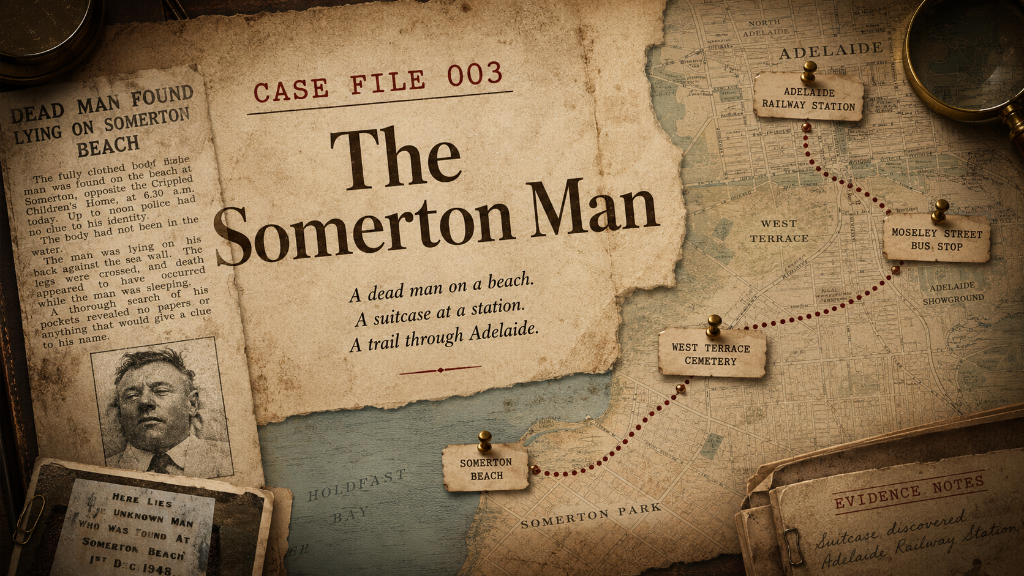
A dead man on a beach. A suitcase at a railway station. A book of poetry. A telephone number. A woman in Moseley Street.
The Somerton Man is not one of those mysteries that stays neatly in one place.
The case moves from Somerton Beach to Adelaide Railway Station. From a suitcase in a cloakroom to a hidden scrap of paper. From a copy of The Rubaiyat of Omar Khayyam to a telephone number. From that telephone number to a woman living in Moseley Street, Glenelg. From a beachside death to an unnamed grave in West Terrace Cemetery. From 1948 to modern DNA research. From anonymity to a possible name.
And still, somehow, the mystery does not completely close.
That is why the Somerton Man belongs in The Settlement Project. Not because this is simply a famous cold case. But because it is a case built from places.
A beach. A railway station. A street. A house. A cemetery.
A map can show what a summary cannot. It can show how close the clues were. How tightly the mystery gathered around one part of Adelaide. How a man with no name still left a trail.
When I began mapping the Somerton Man into The Settlement Project, the case stopped feeling like a collection of strange clues. It became a route.
The question changed. It was no longer only: Who was the Somerton Man? It became: What did these places know before anyone knew his name?
The man without a name
At 6:30 on the morning of 1 December 1948, a man was found dead on Somerton Beach, near Adelaide in South Australia.
He was fully dressed. He was lying near the seawall. His legs were crossed. His pockets held no name. No wallet. No papers. No obvious injury. No clear cause of death.
The first newspaper reports were blunt. A dead man had been found lying on Somerton Beach, opposite the Crippled Children's Home. Police had no clue to his identity.
That detail matters because it fixes the mystery in a real place. Not simply "a beach near Adelaide." But a section of coastline known to local people, near a landmark, close to roads, houses, witnesses, and ordinary morning routines.
Someone had seen him the evening before. More than one witness later recalled a man lying near the beach. At the time, he seemed perhaps drunk or asleep. Only later did those sightings become part of the mystery.
The Somerton Man may have been seen before he was dead. He may have been lying there while life carried on around him. People walked past. The sea moved. The night settled. By morning, he had become a mystery.
The body had not been in the water. He had not drowned. He was dressed like someone who had arrived from elsewhere and stopped at the edge of the land.
In many investigations, the body gives police a beginning. In this one, the body gave them an absence. No name. No address. No papers. No one standing at the edge of the scene saying, "I know him."
For more than seventy years, the world knew him by the place where he was found.
The Somerton Man. A person named by geography.
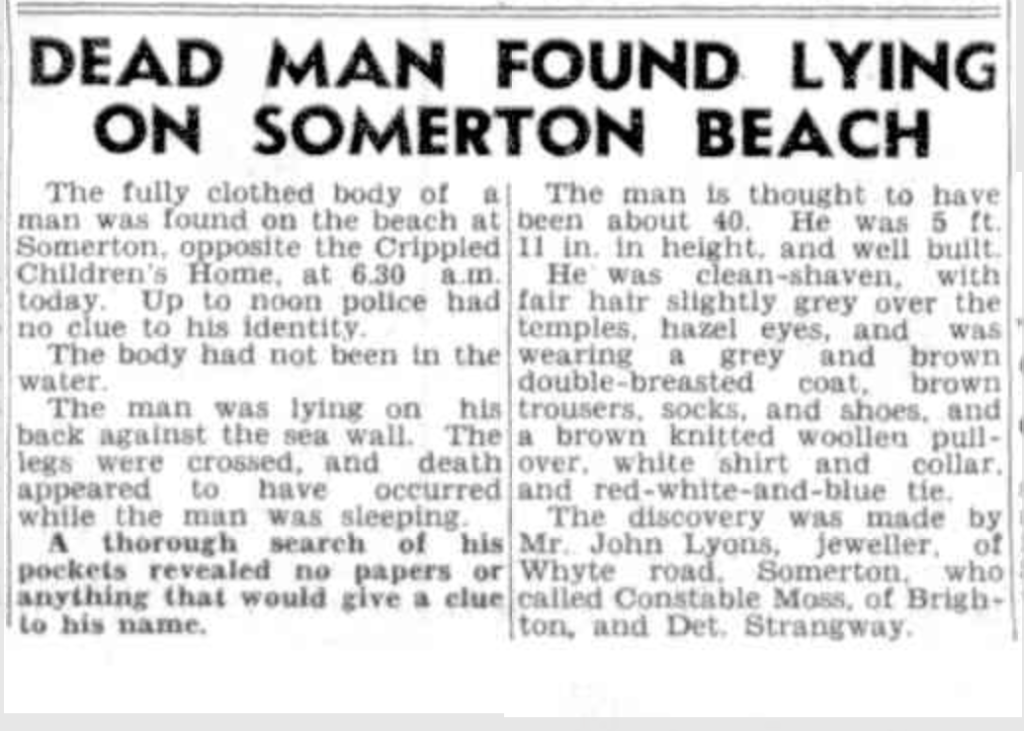
Contemporary newspaper report describing the discovery of the unidentified man on Somerton Beach, opposite the Crippled Children's Home, on 1 December 1948. The News (Adelaide), via Trove, National Library of Australia.
The first problem: identity
In family history, identity usually begins with a name. A baptism. A marriage. A census. A death certificate.
The Somerton Man had none of those when he entered the public record. He was not first known as Carl Webb. He was first known as the unknown man found at Somerton.
His identity was not attached to family. It was attached to place.
Police circulated his fingerprints. People came to view the body. Newspapers published descriptions. His face was photographed. A plaster cast was later made. The public was invited, again and again, to recognise him.
Recognition did not come.
Contemporary reports described him as about forty, around five feet eleven inches tall, well built, clean-shaven, with fair hair greying at the temples and hazel eyes. He wore a grey and brown double-breasted coat, brown trousers, socks and shoes, and a brown knitted pullover over a white shirt and collar.
He sounded, on paper, like someone who should have been missed.
The labels had been removed from some of his clothing. His pockets did not contain identity documents. In an ordinary death, missing labels might mean very little. In the Somerton Man case, every small absence became part of the puzzle.
Why remove labels? Was it done by the man himself? By someone else? Was it an attempt to conceal identity? Or was it a habit, a coincidence, a detail made larger by everything that came after?
Almost every clue feels meaningful. And yet not every strange fact is proof.
Why the map matters
This is where The Settlement Project changes the way the case feels.
A written timeline can tell us what happened. A map shows us where the mystery gathered.
On The Settlement Project map, the early Somerton Man locations form a tight pattern across Adelaide and the coastal suburbs:
- Somerton Beach — where the body was found
- Moseley Street, Glenelg — where the telephone number led
- Adelaide Railway Station — where the suitcase was left
- West Terrace Cemetery — where the unknown man was buried
These are not abstract clues. They are places that can be pinned, measured, and followed.
The case is not scattered randomly across Australia. Its core clues sit within a recognisable urban and coastal landscape. The map lets us ask questions that a normal article cannot fully hold.
Where could he have gone after arriving in Adelaide? How far was the beach from Moseley Street? Why did the clues keep pulling investigators back toward Glenelg? Was the Somerton Man in Adelaide by accident — or was he there for someone?
The map cannot answer those questions by itself. But it shows where the questions live.
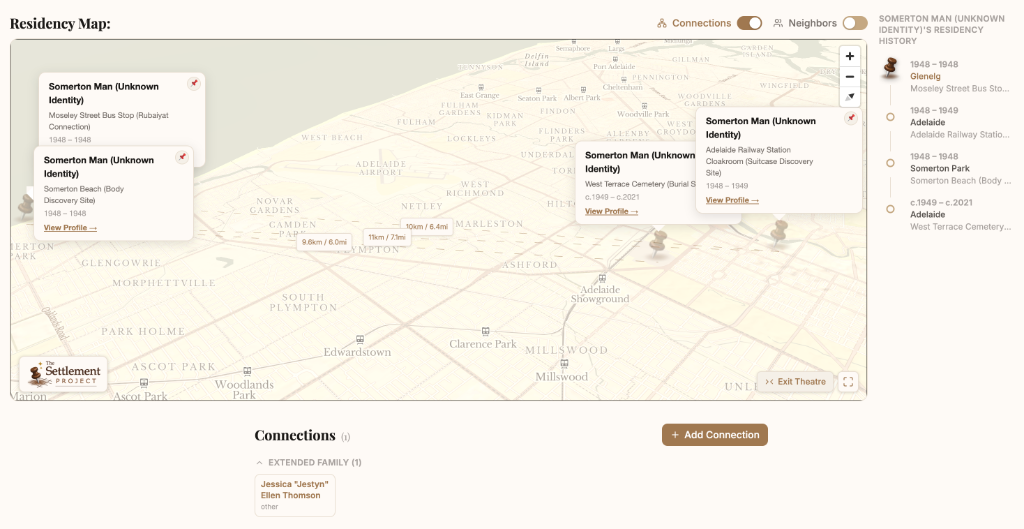
The Settlement Project map showing the key Somerton Man investigation locations across Adelaide, including Somerton Beach, Adelaide Railway Station, Moseley Street, and West Terrace Cemetery.
Murder not ruled out
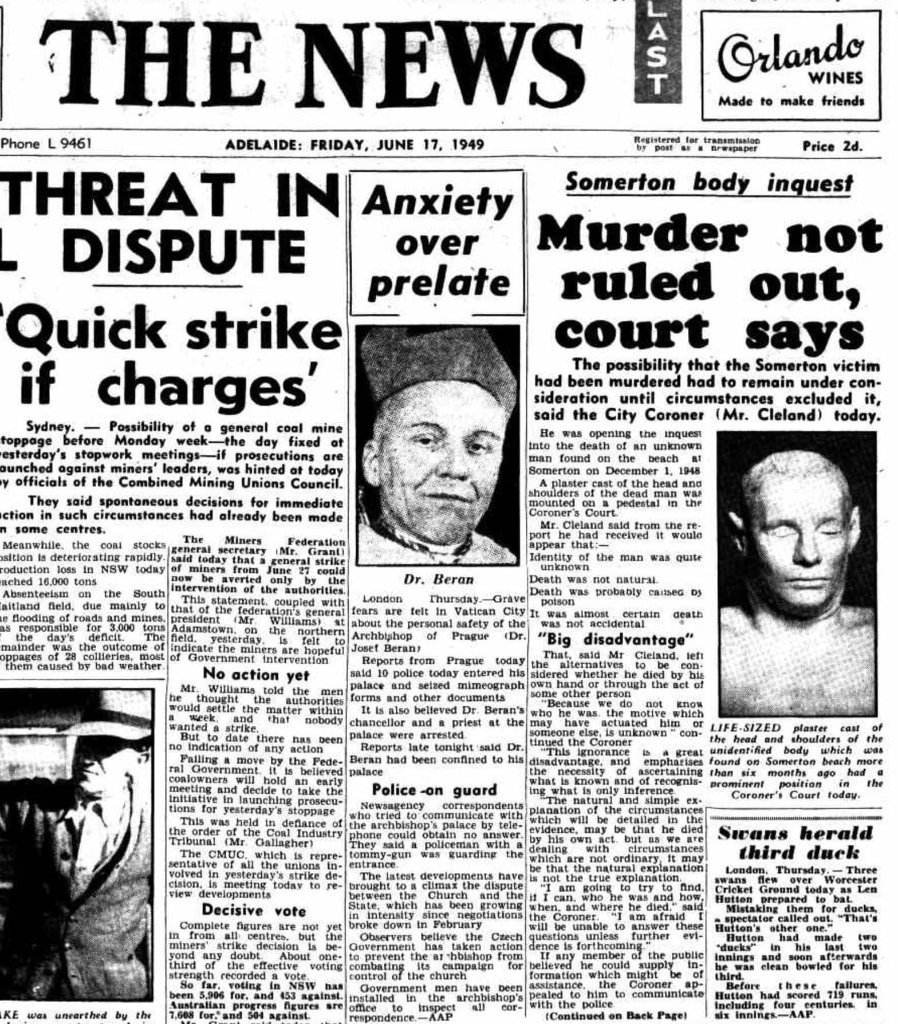
A 1949 report from the inquest, reflecting the uncertainty around the Somerton Man's cause of death. Somerton body inquest, The News (Adelaide), 17 June 1949, via Trove, National Library of Australia.
The Somerton Man's identity was not the only mystery. His cause of death was also uncertain.
The body showed no obvious signs of violence. He had not drowned. Pathological findings led to suspicion of poisoning, but no poison was identified.
The inquest did not provide the clean answer people wanted. One newspaper headline captured the uncertainty bluntly:
Murder not ruled out, court says.
That does not mean murder was proved. It means the door was left open because the evidence could not close it.
The coroner's court heard that death did not appear natural, was probably caused by poison, and was not accidental.
But the path between those findings and a final answer remained unclear. That is why the case did not end with the inquest. It deepened.
The code that may not be a code
The letters written inside the Rubaiyat have been treated for decades as a possible code.
A dead man. A hidden phrase. A mysterious book. A sequence of letters. The Cold War. Australia. No identity.
It is almost impossible not to feel the pull of espionage. But again, feeling is not proof.
The letters may have been a code. They may have been notes. They may have been initials. They may have been a private mnemonic. They may have meant something only to the writer.
This is the strange power of the Somerton Man case. It sits at the edge between evidence and imagination. The clues are real. The certainty is not.
Even if the man was Carl Webb, the markings in the book remain unexplained. Even if we know where he was born, we still do not know why he died on Somerton Beach.
The grave at West Terrace
By June 1949, the man still had no confirmed name. So he was buried as unknown.
West Terrace Cemetery became the final mapped location in the first chapter of the case. The burial was quiet. Contemporary reporting said arrangements were kept secret to prevent curious sightseers attending.
A wooden cross marked the grave. Unknown Man.
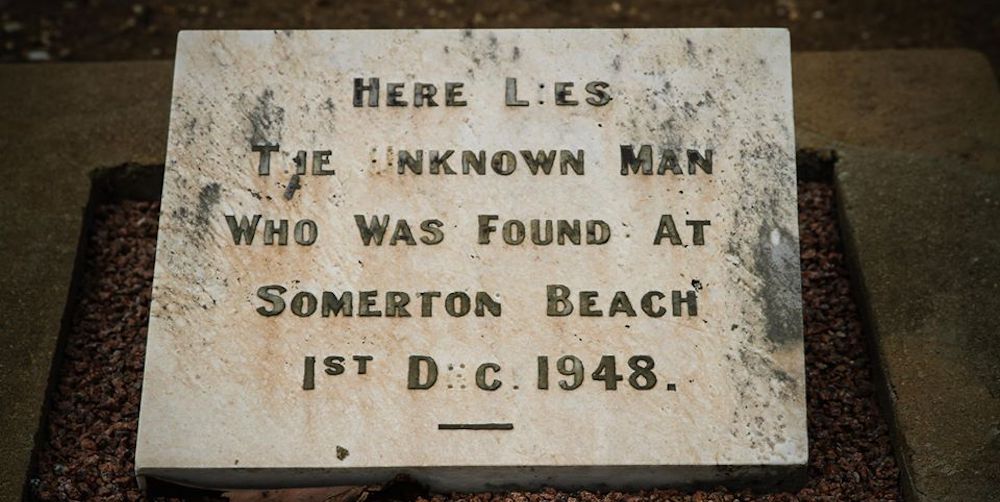
Grave marker for the unknown man found at Somerton Beach. For decades, his grave at West Terrace Cemetery held both a body and an unanswered question.
That phrase is devastating in its simplicity.
For decades, the grave held both a body and a question. People came to it because they wanted to stand near the mystery. They left flowers. They speculated. They tried to restore a name.
Genealogy is usually about recovering connection. This grave represented the opposite: a person cut off from every visible connection he once had. No parents. No siblings. No spouse. No children. No home. Only a place where the state laid him to rest when no one else could claim him.
The exhumation
In 2021, the Somerton Man was exhumed from West Terrace Cemetery.
This was not simply historical curiosity. It was a modern attempt to solve a decades-old identity case using forensic science and DNA.
For more than seventy years, investigators had worked from photographs, witness statements, clothing, dental records, fingerprints, police files, and public memory. Now the investigation could move through genetics.
DNA has transformed cold cases because it can rebuild family links even when names are missing. It can turn an unknown person back into a son, a brother, a husband, or a cousin.
At its core, the modern breakthrough was not only forensic. It was genealogical.
After more than seventy years, the search for a name moved from police files to family trees.
The question became: Whose family tree does this man belong to?
Carl Webb
In 2022, researchers announced that DNA and genealogical work pointed to a likely identity: Carl "Charles" Webb, an electrical instrument maker born in Footscray, Victoria, in 1905.
For the first time, the Somerton Man may have had a name that fit the evidence. Carl Webb had a family. A birthplace. A past. A marriage. A paper trail.
The mystery that had been attached to Somerton Beach began to stretch back toward Melbourne.
But the proposed identification did not end every question.
If the Somerton Man was Carl Webb, what was he doing in Adelaide? Was he looking for someone? Was he connected to Jessica Thomson? What had happened in his life before he reached Somerton Beach? Was his death suicide, natural, accidental, or caused by someone else?
A name matters. A name is huge. But a name is not the same as a full story.
The Somerton Man may no longer be entirely unknown, but he is still not fully understood.
A man named by place
For decades, this man was not named by family. He was named by geography.
The Somerton Man.
The place became the identity.
Now, with the proposed identification of Carl Webb, the case has shifted. The man may have his name back. But the old name still tells us something important.
It tells us where the world first met him. It tells us where the mystery began. It tells us that place can hold a person when records do not.
That is what The Settlement Project is built to notice.
Our lives do not happen only in dates. They happen in streets. Stations. Beaches. Hospitals. Cemeteries. Boarding houses. Family homes. Workplaces.
Places remember differently than documents do.
A document can say unknown. A place can say here.
The places and what they reveal
| Place | What it gave investigators |
|---|---|
| Somerton Beach | The body |
| Adelaide Railway Station | The suitcase |
| Glenelg / Moseley Street | The Rubaiyat connection |
| Jessica Thomson's reported residence | The unresolved personal link |
| West Terrace Cemetery | The unidentified burial |
| Footscray / Melbourne | The proposed identity of Carl Webb |
In a traditional article, those locations become paragraphs. On The Settlement Project, they become pins. Each pin asks a question: Why here? Why this place? Why this connection?
This is where the map becomes more than decoration. The map is the investigation structure.
What I know, what I suspect, and what I still need to check
What I know
- A man was found dead on Somerton Beach on 1 December 1948, carrying no identification
- Contemporary reports placed the body near the seawall, opposite the Crippled Children's Home
- A suitcase believed to be connected to him was found at Adelaide Railway Station
- A scrap reading Tamám Shud was found concealed in his clothing, linked to The Rubaiyat of Omar Khayyam
- A telephone number in that book led police to Jessica Ellen Thomson in Glenelg
- The man was buried at West Terrace Cemetery in June 1949 as an unknown man
- His remains were exhumed in 2021 for DNA testing
- Researchers in 2022 proposed that he was Carl "Charles" Webb, born in Footscray, Victoria, in 1905
- The exact cause of death remains unresolved
What I suspect
- The geography of the case matters more than many summaries suggest
- Glenelg was not an incidental location
- The connection to Jessica Thomson remains one of the most important unresolved parts of the case
- A confirmed name does not automatically solve the mystery
What I still need to check
- The original South Australian police file and full inquest record
- Primary evidence for Jessica Thomson's exact address
- Contemporary telephone directory records and electoral roll entries for Moseley Street
- Official confirmation of whether the Carl Webb identification has been formally accepted
- Records relating to Carl Webb's marriage, movements, and reasons for being in Adelaide
Call for help
If you have information connected to the Somerton Man, Carl "Charles" Webb, Jessica Ellen Thomson, Moseley Street, Somerton Beach, Adelaide Railway Station, West Terrace Cemetery, or any original records connected to the investigation, I would be grateful to hear from you.
I am especially interested in:
- Original newspaper reports from Adelaide in 1948 and 1949
- Police or inquest references
- Electoral roll entries for Jessica Thomson
- Telephone directory records connected to the Moseley Street number
- Records relating to Carl Webb's movements before December 1948
- Material relating to the exhumation and DNA identification
If you are connected to the Webb, Thomson, or Somerton Park families, I would especially love to hear from you.
Because sometimes a mystery is not solved by one dramatic discovery. Sometimes it is solved by putting every place, every record, and every person back into the same map.
And in the case of the Somerton Man, that map begins on a beach. But it does not end there.
Appendix: Working Case Timeline
30 November 1948 — A suitcase later believed to be connected to the Somerton Man is checked into the cloakroom at Adelaide Railway Station.
Evening of 30 November 1948 — Witnesses later recall seeing a man lying near the seawall at Somerton Beach.
1 December 1948 — The body is discovered at 6:30 am. Police report no identification found.
Early December 1948 — Fingerprints circulated. Public invited to identify the man. No identification made.
January 1949 — A suitcase at Adelaide Railway Station cloakroom is linked to the man. Contents examined.
17 June 1949 — Newspaper reports from the inquest state that murder had not been ruled out.
June 1949 — The man is buried at West Terrace Cemetery as unknown. Arrangements kept secret.
1949 — A scrap of paper reading Tamám Shud is found concealed in a fob pocket. A copy of The Rubaiyat of Omar Khayyam is located. A telephone number inside it leads police to Jessica Ellen Thomson in Glenelg.
Subsequent decades — Multiple investigations and theories. The case never officially closed.
2021 — The remains are exhumed from West Terrace Cemetery for DNA testing.
2022 — Researchers propose identification as Carl "Charles" Webb, born 1905 in Footscray, Victoria.
Ongoing — The identification remains proposed rather than formally confirmed. The cause of death remains officially undetermined.
This is a working case file. Sources, locations, and evidence assessments are updated as research progresses. If you have relevant information, please get in touch.
The Question Under Investigation
Was the Somerton Man truly Carl "Charles" Webb — and if so, why did he die at Somerton Beach?
Current Assessment
Current Likelihood
HighSupporting the Theory
DNA and genealogical research (2022) points to Carl "Charles" Webb, born Footscray, Victoria, 1905
Physical description matches known details of Webb
Webb's background as an electrical instrument maker aligns with the Somerton Man's well-kept hands and appearance
Webb had a prior connection to Adelaide through personal relationships
The Tamám Shud slip and Rubaiyat link to Jessica Thomson remain geographically consistent with Webb's known movements
Against the Theory
The identification has not been formally confirmed by South Australian authorities
No documentary evidence directly places Webb at Somerton Beach on 1 December 1948
Cause of death remains unknown — suicide, accident, or murder cannot be ruled out
The cipher-like markings in the Rubaiyat remain unexplained even if Webb is identified
Missing Evidence — Still Sought
Official confirmation of the Carl Webb identification from South Australian authorities
Carl Webb's movements in the weeks before December 1948
Primary records placing Webb in Adelaide prior to his death
Full inquest transcript and South Australian police file
Electoral roll and telephone directory records for Jessica Thomson's Moseley Street address
Any direct documentary evidence linking Webb personally to Jessica Thomson
Current Verdict
The DNA and genealogical evidence makes Carl "Charles" Webb the most credible proposed identification to date. But a name is not a full story. The cause of death, the reason for his presence at Somerton Beach, and the nature of his connection to Jessica Thomson remain unresolved. The case is plausible but unproven, and the geography still holds clues that documents alone cannot answer.
📬 This Case Is Still Open
Can You Help Solve This Case?
If you have records, photographs, family stories, local knowledge, or other information related to this case, we'd love to hear from you.
Submit a Lead →All leads are reviewed and credited where appropriate.